Management System Certification

GQCL provides accredited and internationally recognized ISO certification services across a broad portfolio of management systems, helping organizations achieve excellence in quality, environment, safety, security, energy, education, and sustainability.

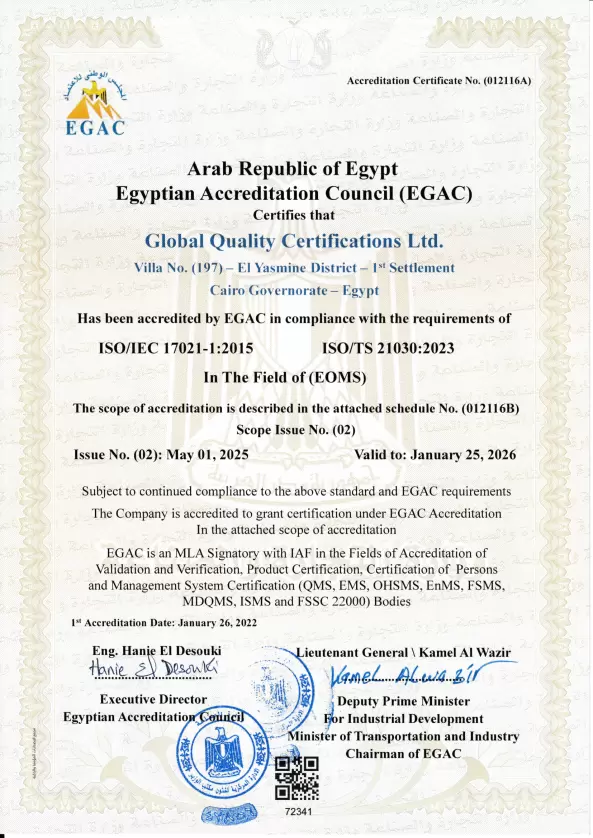
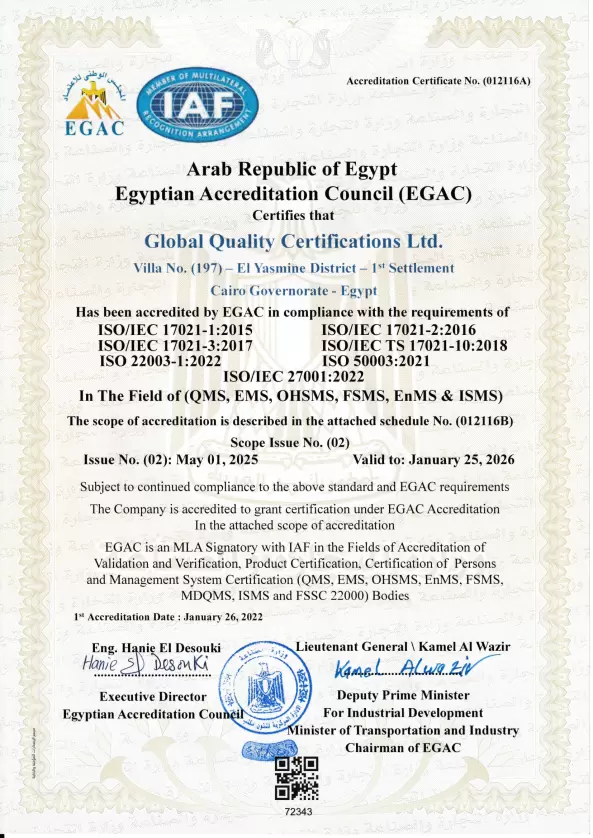
GQCL is accredited by EGAC in compliance with the requirements of: ISO/IEC 17021-1:2015 ISO/IEC 17021-2:2016 ISO/IEC 17021-3:2017 ISO/IEC 17021-10:2018 ISO 50003:2021 ISO 22003-1:2022 ISO/IEC 27001:2022 ISO/TS 21030:2023 / In the field of:

  • ISO 9001:2015 – Quality Management Systems (QMS)
  • ISO 14001:2015 – Environmental Management Systems (EMS)
  • ISO 45001:2018 – Occupational Health and Safety Management Systems (OHSMS)
  • ISO 27001:2022 – Information Security Management Systems (ISMS)
  • ISO 50001:2018 – Energy Management Systems (EnMS)
  • ISO 21001:2018 – Educational Organizations Management Systems (EOMS)
  • ISO 22000:2018 - Food Safety Management Systems (FSMS)

GQCL provides direct certification services for other management systems:

  • ISO 22301:2019 – Business Continuity Management Systems (BCMS)
  • ISO 13485:2016 – Medical Devices - Quality Management Systems (MDQMS)
  • ISO 28003:2007 – Supply Chain Security Management Systems (SCSMS)
  • ISO 10002:2018 – Customer Satisfaction and Complaint Handling (QMCS)

For other certification services please contact us:info@gqcl.co.uk

First Image
Second Image

Certification Procedures

1. Planning Audits
Determining Audit Objectives, Scope, and Criteria: Establish clear objectives, define the audit’s scope, and set the criteria against which the audit will be conducted.
Audit Team Selection and Assignments: Carefully select audit team members based on competence and suitability for the specific audit and assign roles and responsibilities.
Audit Plan: Develop a comprehensive audit plan detailing the audit’s schedule, resources needed, activities, and any other relevant information.
2. Initial Certification
Initial Certification Audit: Conduct a thorough audit to assess if the organization’s management system meets the criteria for initial certification.
3. Conducting Audits
General Guidelines: Adhere to established procedures and ethical guidelines throughout the audit process.
Opening Meeting: Conduct an opening meeting with the client to outline the audit process, objectives, and expected outcomes.
Communication During the Audit: Maintain clear and open communication with the client throughout the audit process.
Obtaining and Verifying Information: Collect relevant data and information and verify them for accuracy and compliance.
Identifying and Recording Audit Findings: Identify any non-conformities or areas for improvement and document these findings.
Preparing Audit Conclusions: Summarize the audit findings and prepare a draft report for review.
Closing Meeting: Hold a meeting to discuss the audit findings, potential non-conformities, and the next steps.
Audit Report: Prepare a comprehensive audit report detailing the findings, evidence, and conclusions.
Cause Analysis of Nonconformities: Analyze the root causes of any non-conformities identified during the audit.
Effectiveness of Corrections and Corrective Actions: Evaluate the effectiveness of any corrective actions taken in response to audit findings.
4. Certification Decision
General Considerations: Ensure that all certification decisions are made impartially and based on evidence gathered during the audit.
Actions Prior to Making a Decision: Review all audit findings and ensure all necessary steps have been taken before making a certification decision.
Information for Granting Initial Certification: Verify that all criteria for initial certification are met.
Information for Granting Recertification: Assess whether the organization continues to meet the requirements for maintaining its certification.
5. Maintaining Certification
General Guidelines: Outline the requirements for maintaining certification status.
Surveillance Activities: Conduct regular surveillance audits to ensure ongoing compliance.
Recertification: Periodically reassess the organization’s management system to determine eligibility for recertification.
Special Audits: Conduct special audits as needed, based on specific circumstances or non-conformities.
Suspending, Withdrawing, or Reducing the Scope of Certification: Outline the conditions and procedures for suspending, withdrawing, or reducing the scope of certification.
Certification Decision Process
General Principles: Ensure that all certification decisions are made impartially, based on objective evidence of conformity or non-conformity obtained during the audit process.
Actions Prior to Making a Decision: Review all relevant audit findings and verify compliance with all necessary criteria before making any certification decision.
Information for Granting Initial Certification: Determine and document the evidence required for granting initial certification, ensuring compliance with the defined criteria.
Information for Granting Recertification: Establish and document the criteria for granting recertification, including the review of ongoing compliance and performance.
Maintaining Certification
General Requirements: Define the ongoing requirements for maintaining certification, including compliance with the standard and continuous improvement.
Surveillance Activities: Implement and document regular surveillance activities to monitor the certified client’s ongoing compliance with the standard.
Recertification: Outline the process and criteria for recertification, ensuring that the certified client continues to meet the requirements of the standard.
Special Audits: Define the circumstances under which special audits may be required and the process for conducting them.
Suspending, Withdrawing, or Reducing the Scope of Certification: Establish the criteria and process for suspending, withdrawing, or reducing the scope of certification, including conditions and procedures for reinstatement.
Appeals Process
Outline the process for handling appeals from clients regarding certification decisions, ensuring that the process is transparent, impartial, and fair.
Complaints Process
Develop a systematic approach for managing and resolving complaints related to the certification process, ensuring responsiveness and impartiality.
Client Records
Define the requirements for the creation, maintenance, and retention of client records, ensuring confidentiality and security of information.
Introduction
Purpose of Management System Certification: Certification of management systems provides assurance that an organization has implemented a system for managing relevant aspects of its activities, products, and services in line with its policy and international management system standards.
This certification demonstrates that the organization’s management system:
Conforms to specified requirements.
Is capable of consistently achieving its stated policy and objectives.
Is effectively implemented.
Types of Management Systems
Quality Management System (ISO 9001): Focuses on meeting customer requirements and improving customer satisfaction.
Environmental Management System (ISO 14001): Aimed at managing environmental aspects, ensuring compliance with environmental laws, and continually improving environmental performance.
Occupational Health and Safety Management System (ISO 45001): Ensures a safe and healthy working environment by preventing work-related injury and ill health.
Food Safety Management System (ISO 22000): Addresses food safety through the control of food safety hazards.
Information Security Management System (ISO 27001): ISO 27001’s best-practice approach helps organizations manage their information security by addressing people, processes and technology.
Introduction
Purpose: Provide guidelines and rules for the use of Global Quality Certification Ltd. (GQC) Certification Body’s name, certification mark, or logo by certified organizations.
Guidelines for Using Global Quality Certification Ltd. (GQC) Certification Body’s Name and Mark/Logo
General Use:
Certified organizations may use the Global Quality Certification Ltd. (GQC) Certification Body’s name and logo in their communication materials, including electronic media, to indicate their certified status.
The use of the certification body’s name and logo should not imply that the certification body endorses any product, process, or service of the certified organization.
On Products and Product Packaging:
The use of the certification mark or logo directly on products or their packaging is not permitted if it implies product certification.
The certification mark/logo can be used on product packaging or accompanying information if it is clear that the mark/logo relates to the management system and not to product conformity.
In Documents and Advertisements:
Use on business cards, letterheads, marketing materials, and electronic media is permitted, provided it relates to the scope for which certification has been granted.
The logo must not be used in a manner that would mislead the public or customers about the certification status.
Size and Design:
The size, color, and design of the certification mark/logo should not be altered. It must be reproduced in its entirety and in a legible manner.
The certification body’s name and logo should be distinct and separate from the name and marks of the certified organization.
Misleading Use:
Misleading use of the certification body’s name and logo, such as suggesting that a product, process, or service is certified by Global Quality Certification Ltd. (GQC) Certification Body when it is not, is strictly prohibited.
Any incorrect references to the certification system or misleading use of the logo or name could result in suspension or withdrawal of certification.
Monitoring and Compliance
Global Quality Certification Ltd. (GQC) Certification Body reserves the right to monitor the use of its name and logo and to conduct audits for compliance.
Certified organizations are required to correct any misuse immediately upon notification.
Suspension or Withdrawal
In cases of misuse or misrepresentation, Global Quality Certification Ltd. (GQC) Certification Body may take action, including suspension or withdrawal of certification, and legal action if necessary.
References to Certification Status
The certified organization must ensure that no certification document or any part thereof is used in a misleading manner.
Upon suspension, withdrawal, or termination of certification, the use of all advertising material that contains a reference to certification must be discontinued.
Information Requests
Receiving and Processing Information Requests: Establish a protocol for handling external information requests. This includes identifying the appropriate contact point within GQC Ltd. Certification Body, the means of submitting requests (e.g., email, phone, online form), and the expected time frame for responses.
Types of Information Provided: Clearly define the type of information that can be provided, such as certification processes, criteria for certification, and information about certified organizations.
Confidentiality and Disclosure: Outline the boundaries of confidentiality and the extent of information disclosure, especially in relation to certified clients and their certification status.
Complaints Process
Receipt of Complaints: Define a clear process for receiving complaints from external parties, including clients, stakeholders, or the public. This should detail how complaints can be submitted and the acknowledgment process.
Investigation: Outline the steps for investigating complaints, including gathering relevant information, analyzing the complaint, and determining the validity of the complaint.
Resolution and Communication: Develop a procedure for resolving complaints and communicating the decision to the complainant. This includes timelines for resolution and the process for escalation if required.
Recording and Monitoring: Keep records of all complaints and their outcomes. Regularly review these records to identify any recurring issues or trends that need addressing.
Appeals Process
Initiation of Appeals: Detail the process for clients or other parties to appeal certification decisions made by AMY International Certification Body. This includes the timeframe for submitting appeals and the required format for submission.
Appeals Review Committee: Establish an independent appeals committee or process to review appeals. This committee should be impartial and separate from the original decision-making process.
Handling and Resolution of Appeals: Describe the steps for handling and resolving appeals, including reviewing all relevant information, conducting a fair and impartial assessment, and making a decision.
Communication of Decision: Clearly communicate the outcome of the appeal to the appellant, including the reasons for the decision and any further actions to be taken.
Record-Keeping: Maintain records of all appeals and their outcomes for accountability and continual improvement purposes.
Client Records
Maintenance of Records: Ensure the maintenance of accurate and up-to-date records for all clients, including information on certification status, audit reports, complaints, appeals, and other relevant client interactions.
Accredited Certification

Quality Management Systems
View More

Quality Management Systems

Environmental Management Systems
View More

Environmental Management Systems

Occupational Health and Safety Management Systems
View More

Occupational Health and Safety Management Systems

Energy Management Systems
View More

Energy Management Systems

Information Security Management Systems
View More

Information Security Management Systems

Food Safety Management Systems
View More

Food Safety Management Systems

Educational Organizations Management Systems
View More

Educational Organizations Management Systems

Direct Certification

Fast flexible certification for immediate business needs

Hazard Analysis Critical Control Points
View More

Hazard Analysis Critical Control Points

Quality Health Safety & Environment Management Systems
View More

Quality Health Safety & Environment Management Systems

Petroleum, Petrochemical and natural gas industries Sector-specific Quality Management systems
View More

Petroleum, Petrochemical and natural gas industries Sector-specific Quality Management systems

Learning Services for Non-Formal Education and Training
View More

Learning Services for Non-Formal Education and Training

Anti-bribery Management Systems
View More

Anti-bribery Management Systems

Cosmetics Good Manufacturing Practices (CGMP)
View More

Cosmetics Good Manufacturing Practices (CGMP)

Security and Resilience Business Continuity Management Systems
View More

Security and Resilience Business Continuity Management Systems

Event Sustainability Management Systems
View More

Event Sustainability Management Systems

Management Systems for Private Security Operations
View More

Management Systems for Private Security Operations

Medical Laboratories
View More

Medical Laboratories

Heating and Cooling Systems in Buildings
View More

Heating and Cooling Systems in Buildings

Medical Devices Quality Management Systems
View More

Medical Devices Quality Management Systems

Quality Management Customer Satisfaction
View More

Quality Management Customer Satisfaction

Retrodynamic Pumps, Hydraulic performance acceptance tests, Grades 1,2, and 3
View More

Retrodynamic Pumps, Hydraulic performance acceptance tests, Grades 1,2, and 3

Technical Specifications for Centerfugal Pumps - Class II -
View More

Technical Specifications for Centerfugal Pumps - Class II -

End-suction Centrifugal Pumps
View More

End-suction Centrifugal Pumps

Stainless Steel Tubes Dimensions, Tolerances and Conventional Masses per Unit Length
View More

Stainless Steel Tubes Dimensions, Tolerances and Conventional Masses per Unit Length

Q2 API spec Q2
View More

Q2 API spec Q2

Good Manufacturing Practices (GMP)
View More

Good Manufacturing Practices (GMP)

Good Manufacturing Practices (GMP) MS 1514 For Food
View More

Good Manufacturing Practices (GMP) MS 1514 For Food

Good Hygiene Practices (GHP)
View More

Good Hygiene Practices (GHP)

The Halal requirements in accordance with islamic laws
View More

The Halal requirements in accordance with islamic laws

ORGANIC SYSTEM
View More

ORGANIC SYSTEM

Method of Analysis for the Detection of Genetically Modified Organisms (GMO)
View More

Method of Analysis for the Detection of Genetically Modified Organisms (GMO)

Plastics piping systems for water supply, drainage and sewerage under pressure — Polyethylene (PE)
View More

Plastics piping systems for water supply, drainage and sewerage under pressure — Polyethylene (PE)

Social Responsibility
View More

Social Responsibility

Engineering, Procurement, Construction, and Commissioning
View More

Engineering, Procurement, Construction, and Commissioning

Artificial Intelligence Management System
View More

Artificial Intelligence Management System


Get in touch

We're here to support your business with expert guidance in quality, compliance, and certification. Reach out to discuss how we can help you achieve operational excellence and meet international standards.
Your experience on this site will be improved by allowing cookies Cookie Policy